

The Science of Microbiome Matcha: Why GOZEN Biome Is Different
Most people assume matcha is matcha. A green powder, steeped in ceremony, good for focus, better than coffee. The claims have become background noise: antioxidants, energy, calm alertness. The category has expanded so quickly that distinction has become almost impossible from the outside. It is not impossible from the inside. What separates one matcha from another is not the packaging, the provenance story, or the price point. It is the biology — specifically, what survives the journey from leaf to cell, and in what form. This is where the real conversation about matcha begins. And it is the conversation that GOZEN Biome was built around. The question is not whether matcha is good for you. The question is how much of it actually reaches your cells — and in what form.
Matcha and green tea come from the same plant — Camellia sinensis.
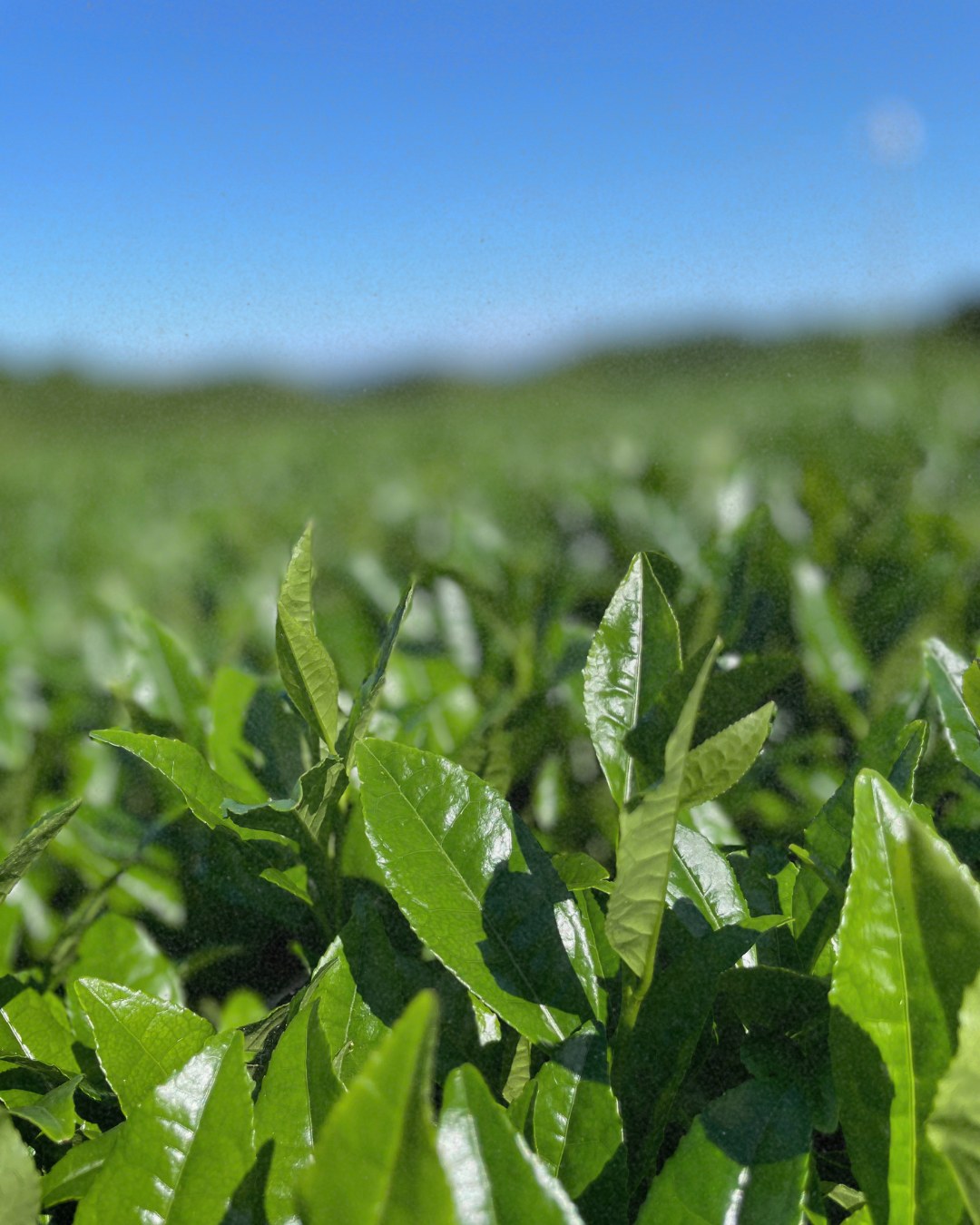
What separates them is the method of cultivation and consumption. Standard green tea is brewed. The leaf is steeped in water, a fraction of its bioactive compounds are extracted, and the leaf — along with most of its nutrient content — is discarded. You drink a diluted extraction of a small portion of the plant's biology. Matcha is different in a structurally important way. The entire leaf is consumed. In the weeks before harvest, matcha plants are shade-covered — traditionally with bamboo and straw, now often with specialist cloth — blocking 70 to 90 per cent of direct sunlight. This triggers a biological stress response: the plant increases its chlorophyll and L-Theanine production, concentrating these compounds in the leaf to compensate for reduced photosynthesis. The shade-grown leaves are then stone-ground into a fine powder, which is whisked directly into water and consumed whole. No steeping, no extraction, no discarded plant material. The result is a catechin concentration approximately ten times higher than brewed green tea, with a corresponding increase in L-Theanine, chlorophyll, and the full spectrum of the leaf's bioactive compounds. The shade-grown leaf is the foundation. Everything else — the science, the heritage, the biotechnology — is built on what happens in those final weeks before harvest.
The dominant catechin in matcha is EGCG — epigallocatechin gallate — which has been the subject of extensive clinical research. EGCG crosses the blood-brain barrier, demonstrates neuroprotective properties, activates AMPK (the body's master metabolic regulator), and has been shown to modulate immune function and reduce chronic inflammation. These are well-documented mechanisms with substantial published evidence. This is the baseline. This is what good matcha does. The question is how much of it your body can actually use.
The Bioavailability Problem
Bioavailability is the proportion of a consumed compound that enters systemic circulation and exerts an active effect. It is the difference between what a label claims and what your cells receive. For most oral supplements, bioavailability is the critical failure point. Consider the journey a bioactive compound takes from manufacture to absorption. It must survive processing (heat, pressure, oxidation). It must survive storage (typically months in a warehouse, then weeks on a shelf). It must survive the digestive process: the acid environment of the stomach, the enzymatic breakdown of the small intestine, the selective permeability of the gut wall. At each stage, a percentage is lost. For many isolated supplements — extracted compounds packaged into capsules or powders — the cumulative loss between stated dose and actual cellular delivery can be significant. Bioavailability of oral supplements varies widely, but for many isolated compounds the range is 5 to 30 per cent of the labelled quantity.
The supplement industry's response has largely been to increase the dose. If 200mg reaches the cell at 10 per cent bioavailability, the logic goes, increase the dose to 2,000mg. This approach compounds the problem: it drives up cost, increases the risk of compound interaction, and still does not solve the fundamental issue — the delivery mechanism is wrong. Higher doses do not solve low bioavailability. They make the inefficiency more expensive. The more elegant solution is to reconsider how the compound is delivered in the first place. Food matrices — the complex biological structures of whole foods — deliver nutrients differently than isolated supplements. Compounds consumed within their natural cellular context are absorbed with greater efficiency, because the body recognises and processes the broader matrix in which they are embedded. This is why eating a tomato delivers lycopene more effectively than a lycopene capsule. The food matrix is not merely a vehicle — it is part of the delivery mechanism. Matcha, consumed whole, is already one step ahead of supplement culture. But GOZEN took this logic further.
GOZEN's Biotechnology: Growing the Benefit Into the Leaf
The core of what GOZEN has developed is a proprietary biotechnology that embeds beneficial compounds — specifically postbiotics — directly into the cellular structure of the matcha leaf during cultivation.
This is not a post-harvest addition. It is not a coating, a spray, or an infusion applied to the finished powder. The biology is introduced during the growth phase of the plant itself, allowing the compounds to become structurally integrated into the leaf at a cellular level. The distinction matters enormously. We do not add probiotics to matcha. We grow them into it. The biology is embedded — not supplemented. To understand why, it helps to clarify the terminology. Probiotics are live microorganisms that, when consumed in sufficient quantities, confer a health benefit on the host. Postbiotics are the bioactive compounds produced by probiotic microorganisms — the metabolites, enzymes, and structural components that deliver the biological effect. When probiotics are consumed as isolated supplements — capsules, powders, drinks — they face the same attrition problem as any other oral compound. Live microorganisms must survive manufacture, storage, the acid environment of the stomach, and the transit of the small intestine before reaching the colon where they can establish. Survival rates vary significantly, and the efficacy of many probiotic supplements is directly constrained by delivery. GOZEN's approach bypasses this entirely. By growing the postbiotic compounds into the leaf structure during cultivation, the bioactives are protected by the plant's own cellular architecture. They are not separate organisms navigating a hostile digestive environment. They are structurally embedded in the food matrix — consumed as part of a whole food, delivered with the natural advantages of the matrix.
The result, according to our clinical studies, is bioavailability up to ten times greater than isolated postbiotic supplements — not because the dose is higher, but because the delivery mechanism works. This is GOZEN's own intellectual property. It is not a process available to other matcha producers. It is the product of years of research, and it is the reason GOZEN Biome occupies a category that no other matcha brand currently does. What This Means in Practice For the consumer, the implications are straightforward — but worth articulating precisely.
First: GOZEN is not a matcha to which a supplement has been added. It is a matcha in which the beneficial biology is inherent. The difference is not semantic. It affects bioavailability, stability, and the integrity of the product from farm to cup. Second: GOZEN requires no additional products. There is no companion probiotic capsule, no powder to mix in, no regime to maintain. The full biological stack — EGCG, L-Theanine, catechins, postbiotics — is present in a single daily ritual. Third: because the compounds are embedded in a whole food matrix, they benefit from the matrix effect described above. The food is the delivery mechanism. This is the most fundamental departure from supplement culture. One ritual. The complete biology. No regime required.
The practical effects reported by GOZEN users are consistent with the science. Improved sleep quality and measurable increases in deep sleep duration. Enhanced cognitive clarity — specifically the alphawave brainwave state associated with calm, sustained focus. Faster athletic recovery, supported by WHOOP and Oura data from users within the Samurai Circle. Reduced brain fog and more consistent energy without the cortisol spike associated with caffeine-only stimulation. These are not exceptional outcomes. They are the expected outcomes of a product whose biology has been designed to work. GOZEN Farms: The Foundation of the Science The biotechnology GOZEN has developed is only as good as the leaf it is applied to. And this is where the heritage of GOZEN Farms becomes structurally important — not as a marketing narrative, but as a quality prerequisite. GOZEN Farms has cultivated ceremonial-grade matcha in Kagoshima, Japan since 1635. Kagoshima prefecture, on the southern tip of Kyushu, offers conditions that are difficult to replicate: a mild, humid climate, mineral-rich volcanic soil derived from the Sakurajima geological region, and a growing tradition that has been refined across four centuries of continuous cultivation. The soil is alive — literally. The microbial ecosystem of the Kagoshima farmland is one of the reasons the area produces matcha of exceptional quality. Living soil, rich in bacterial and fungal diversity, supports plant health in ways that manufactured growing media cannot replicate. The plants grown in this environment are biologically richer from the outset. G O Z E N B I O M E · The Science of Microbiome Matcha gozenbiome.com · Page 8 Shade cultivation is conducted with the precision of a craft developed over generations. The timing — when covers are applied, how long the shade period lasts, when the covers are lifted — affects the LTheanine and chlorophyll content of the final leaf in ways that require judgment as much as measurement. This is knowledge carried by the master growers of GOZEN Farms, accumulated over centuries of practice. Harvest is still conducted by hand. The selection of leaves — typically only the youngest, most tender growth, the first flush of the season — determines the catechin profile of the finished powder. The leaves are then stone-ground in small batches at low temperature, preserving the enzymatic and chemical integrity of the bioactives that would be degraded by heat or high-speed processing. Four centuries of one craft. The heritage is not the story. It is the reason the science is possible. The biotechnology GOZEN has developed is applied within this environment — to a leaf of exceptional quality, grown in conditions of exceptional care. The two are not separable. The innovation is built on the foundation of the farm. The Conclusion the Science Arrives At The matcha category has a marketing problem. Claims have accumulated beyond their scientific basis. Words like "superfood", "antioxidant-rich", and "brain-boosting" have been applied so broadly that they have lost their precision. GOZEN Biome is not a response to the marketing. It is a response to the science.
The question that drove the development of GOZEN was not "how do we make matcha more appealing?" It was "how do we make it work as well as the biology allows?" The answer — four centuries of Japanese agricultural tradition, combined with proprietary probiotic biotechnology that grows beneficial compounds into the leaf itself — is not a simple one. It took time, research, and a willingness to reject the shortcuts that define most of the supplement industry.
The result is a product that occupies a category of one. Not a matcha with added benefits. A matcha re-engineered from the inside — one in which the biology has been grown in, structurally embedded, and delivered as a whole food with the full advantage of its natural matrix. The product is the conclusion of the science. Not a marketing claim that happens to reference it. If you have read this far, you already understand the distinction. What remains is only the decision. Do you want to experience life with an edge?

Leave a comment
This site is protected by hCaptcha and the hCaptcha Privacy Policy and Terms of Service apply.